
What's the difference between ablative and non-ablative laser?
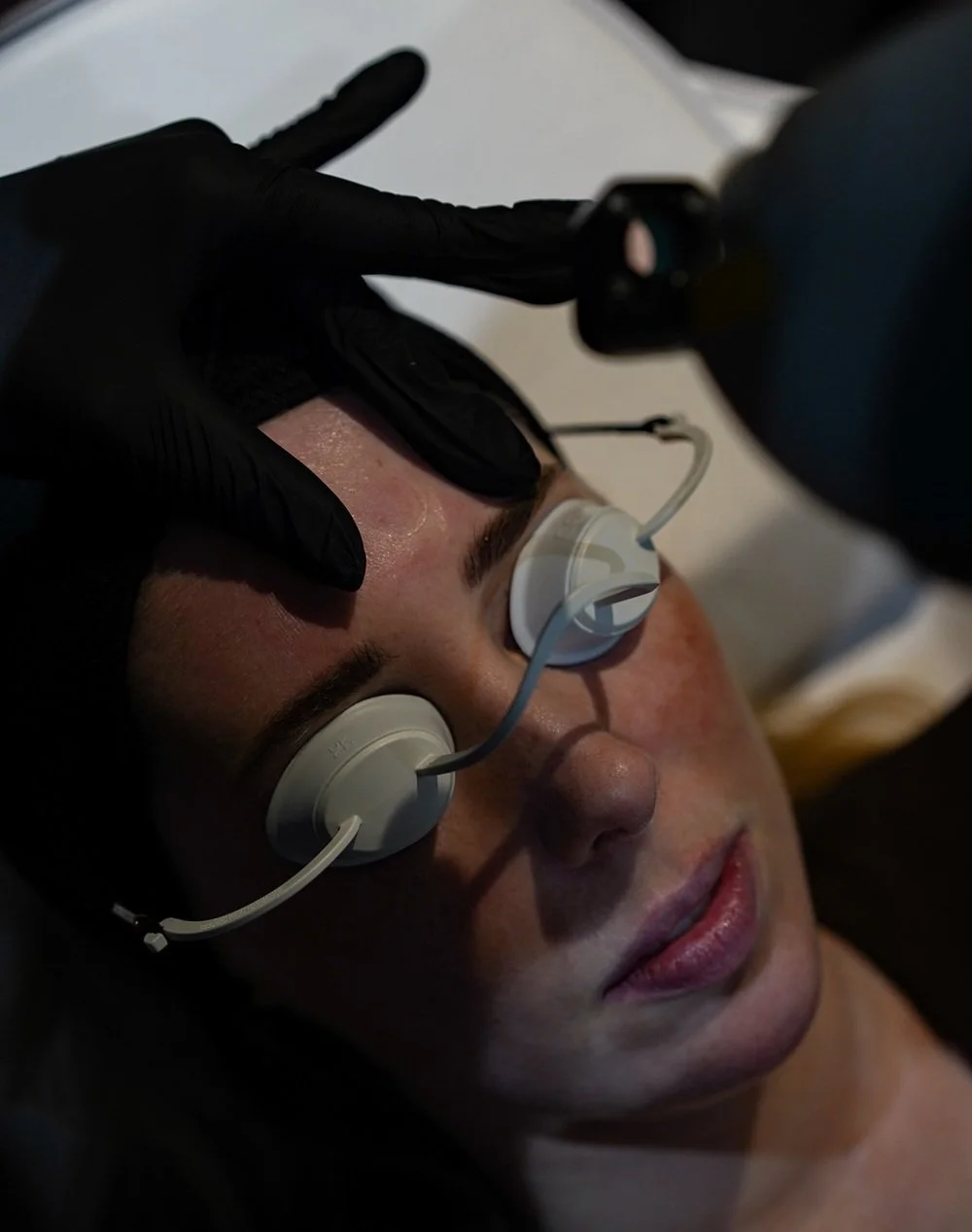
Have you ever started researching laser treatments and quickly found yourself lost in a maze of terminology? It's one of the most common points of confusion I see in clinic, and honestly, it matters. Because understanding the difference between ablative and non-ablative laser isn't just useful background knowledge. It's the thing that helps us choose the right treatment for your skin, your lifestyle, and the results you're actually after.
So let me break it down properly.
How does laser actually work?
Before we get into the two categories, it helps to understand what laser is actually doing. Laser energy is absorbed by the skin and converted into heat. That heat targets specific structures, whether that's pigment, water in the skin cells, collagen fibres, or blood vessels, depending on the wavelength being used. The key difference between ablative and non-ablative laser is simply what happens to the skin's surface in the process.
What is non-ablative laser?
Non-ablative laser works beneath the surface of the skin without removing or disrupting the outer layer. The energy passes through the skin and stimulates change in the deeper tissue, primarily by triggering collagen production and remodelling, without causing any visible wound at the surface.
This is where several of our most popular treatments come in. ClearLift is sometimes called the lunchtime laser, and that name exists for a reason. There's no surface disruption, no downtime, and most patients go straight back to their day afterwards. It works at a deeper level to stimulate collagen, improve skin laxity, and refresh overall skin quality. ClearSkin PRO targets active acne and congestion, delivering controlled heat to the sebaceous glands to reduce oil production and calm inflammation, again without disrupting the skin's surface. We also use IPL (Intense Pulsed Light) on the Harmony XL Pro, which sits in this same category and is particularly effective for pigmentation, redness, rosacea, and vascular concerns like thread veins.
Non-ablative treatments are ideal for patients who want to maintain and improve their skin quality over time without committing to any downtime. They're also a brilliant starting point for patients in their thirties who are noticing the first signs of change and want to get ahead of it. The results build gradually across a course of treatments rather than arriving in one go, which suits a lot of people's lives and budgets very well.
What is ablative laser?
Ablative laser removes the outer layer of skin. It's a controlled, precise injury to the surface that triggers the body's natural wound-healing response. As the skin repairs itself, it produces new collagen, sheds old damaged cells, and resurfaces. The result, over the weeks that follow, is noticeably smoother, clearer, and tighter skin.
At MUSE, we use the iPixel handpiece on our Harmony XL Pro for ablative laser treatments. It's a fractional ablative technology, which means it treats thousands of microscopic columns of skin rather than the entire surface at once. The untreated skin around each column acts as a healing reservoir, which makes recovery faster and the risk of complications significantly lower than older, fully ablative lasers. It's a much more intelligent way of doing things.
Ablative laser is one of the most effective treatments available for resurfacing the skin. It works brilliantly for deeper lines, acne scarring, sun damage, uneven texture, and skin that's lost its tone over time. The results can be transformative, especially when it's part of a well-considered treatment plan.
The trade-off is downtime. After an ablative session, your skin will be red and sensitive, and it'll go through a peeling or shedding process as it heals. Depending on the depth of treatment, this typically takes around five to seven days. It's not something you'd book the week before a big event, but for the right patient with the right goal, it's absolutely worth planning around.
So which one do you need?
The honest answer is that it depends entirely on what your skin is doing right now, what's bothering you most, and how much time you can realistically take for recovery.
If you're dealing with more established concerns, deeper lines, textural damage, acne scarring, or significant sun damage, ablative laser is likely going to give you the most meaningful result. One well-planned ablative session can achieve what might take several non-ablative sessions to approach.
If your concerns are more about skin quality, brightness, and tone, or if you're managing active acne, pigmentation, or visible redness, non-ablative treatments like IPL and ClearSkin PRO can make a significant difference without any disruption to your routine. And if downtime simply isn't an option right now, non-ablative laser is a smart, effective route that still delivers real, cumulative results.
It's also worth saying that for a lot of patients, the answer isn't either/or. We often use both as part of a longer treatment plan, building a strong foundation with non-ablative work and layering in an ablative treatment when the timing is right.
Why getting this right matters
Laser treatments, used correctly, are some of the most effective and evidence-based tools in aesthetic medicine. The right laser, the right settings, the right skin assessment, and the right aftercare all change the outcome significantly. This is something I feel strongly about, because laser done well genuinely transforms skin. And laser done without proper assessment is simply a missed opportunity.
At MUSE, every laser patient goes through our Alma IQ skin analysis before treatment. This gives us an objective, detailed picture of what's happening across the different layers of the skin, so every decision we make is grounded in clinical evidence rather than guesswork. It's the kind of detail that separates a treatment that genuinely changes your skin from one that simply passes over it.
Laser isn't something to be feared. In the right hands, it's one of the most powerful ways to resurface, restore, and maintain your skin for the long term. If you'd like to find out which approach is right for you, head to the link in bio to book a consultation at our York or Harrogate clinic. So what's the key difference?
The simplest way to think about it is this: skin boosters treat the quality of your skin, and dermal fillers treat the structure of your face. One is about radiance, hydration, and regeneration. The other is about volume, lift, and architecture.
That said, they're not mutually exclusive. In fact, some of the most satisfying treatment plans I put together for patients combine both. We might use filler to restore some of the volume loss in the mid face and then layer in a skin booster to work on texture and radiance. The two treatments complement each other beautifully when they're used thoughtfully.